
The full, current guide is our M-Sten research guide.
M-Sten is sold by SARMs Store strictly as a research compound. Nothing on this page is medical advice or an instruction for human use.
Methylstenbolone has a research record, but not the kind most people are looking for. There are no efficacy trials. What exists instead is a documented history in the supplement market, a set of analytical and metabolism studies produced so that anti-doping laboratories could detect it, and a small but consistent series of published case reports describing serious liver injury.
What methylstenbolone is
Methylstenbolone is chemically 2,17-alpha-dimethyl-5-alpha-androsta-1-en-17-beta-ol-3-one. It is the 17-alpha-methylated analogue of stenbolone, an androgen described in the pharmaceutical literature of the 1960s but never widely marketed. Two structural features define it.
The 2-methyl group on the A ring is associated with increased anabolic activity and resistance to metabolism by 3-alpha-hydroxysteroid dehydrogenase, a feature it shares with methasterone and methenolone.
The 17-alpha-methyl group makes the compound orally active by protecting it from first-pass hepatic metabolism. This is the same modification found in Epistane, methasterone and the older oral androgens, and it is the structural feature most consistently associated with cholestatic liver injury across the class. Here that is not a theoretical concern, because the case reports exist.
Methylstenbolone was never a pharmaceutical. It appeared on the supplement market around 2011 and 2012, sold openly as a prohormone with aggressive marketing. It is not a prohormone in any meaningful sense: it is an active oral androgen.
What the research found
Efficacy. There are no published human trials of methylstenbolone for strength, lean mass or any other performance outcome. No effect size can be quoted, and this page does not quote one.
Metabolism and detection. Geldof and colleagues published metabolism work on methylstenbolone using human liver microsomes and a chimeric mouse model, characterising the metabolites needed to detect the compound in urine. Work of this kind established the structure, confirmed extensive hepatic metabolism and provided the detection markers now in routine use. It is solid science about identification, not about benefit.
Market surveillance. Analytical surveys of supplements from the early 2010s repeatedly found methylstenbolone in products, sometimes declared and sometimes not. The broader pattern is captured by Van Wagoner and colleagues in JAMA in 2017: of 44 products sold online as SARMs, only 52 per cent contained any SARM at all, and 39 per cent contained a different unapproved drug.
Harm. This is the clinical literature that concerns methylstenbolone. Agbenyefia and colleagues, in 2014, reported cholestatic jaundice in a previously healthy 26-year-old man after a product that contained methylstenbolone together with a second designer steroid, dymethazine.
The closely related methasterone has a larger case literature. Shah and colleagues, in Clinical Gastroenterology and Hepatology in 2008, described cholestatic liver injury in five people, and Nasr and Ahmad, in Digestive Diseases and Sciences in 2009, reported severe cholestasis with renal failure. Geldof and colleagues also found methasterone in a product labelled as methylstenbolone. The consistency across this structural family is the point.
Side effects reported
The dominant finding is hepatotoxicity, specifically a cholestatic pattern of drug-induced liver injury. In the published cases the presentation is typically jaundice and severe itching, with bilirubin rising steeply while transaminases are only moderately raised, and recovery taking weeks to months after stopping. Renal failure alongside severe cholestasis has been reported with methasterone, a serious complication.
Beyond the liver, the effects expected from a potent non-aromatising oral androgen apply: suppression of endogenous testosterone and luteinising hormone, substantial falls in HDL cholesterol, and raised blood pressure. Because methylstenbolone is not aromatised, oestrogen-related effects are less prominent, which was historically part of its marketing.
Comparison with related compounds
Compared with SARMs, the difference is not one of degree. Ostarine and LGD-4033 are non-alkylated, have phase I to III and phase I and II human data respectively, produced modest lean mass gains, and did not raise liver enzymes in the trials. Methylstenbolone is a methylated compound with no efficacy data and a published record of cholestatic liver injury. Compared with Epistane, the structural risk is the same class risk; Epistane’s distinguishing feature is anti-oestrogenic character, methylstenbolone’s is the 2-methyl A ring. Compared with Trenavar, methylstenbolone carries the 17-alpha-methyl group that Trenavar lacks, which is the most relevant difference between them.
How to check a supplier
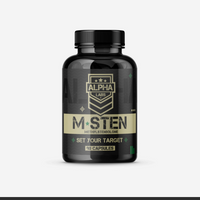
For a compound with a documented harm record and a history of appearing undeclared in other products, verification is the only sensible approach. Ask for the batch-specific certificate of analysis from an independent laboratory, with identity confirmed by HPLC or LC-MS, a stated purity figure, and a batch number matching the bottle. The label should carry the chemical name alongside the market name, the amount per capsule, the capsule count and a research-only notice. Alpha Labs M-Sten is made in the UK at 5 mg per capsule, 90 capsules per bottle, and batch certificates of analysis are being published on the product page as testing is completed.
Frequently asked questions
Is there any human efficacy research on methylstenbolone? No. There are no controlled trials measuring strength, lean mass or any performance outcome.
What is the published research on it then? Metabolism and detection work for anti-doping purposes, market surveillance analyses, and case reports of liver injury.
How serious are the liver reports? Serious. Published cases describe cholestatic jaundice with markedly raised bilirubin and prolonged recovery, and the related compound methasterone has been linked to renal failure.
Why is methylstenbolone considered high risk? It combines 17-alpha-alkylation, the feature most associated with cholestatic liver injury, with no safety data of its own.
Related reading
- Epistane (methylepitiostanol): the research
- Trenavar (trendione): what the evidence says
- SARMs versus prohormones
- Are SARMs safe? What the studies and case reports show
- Browse the range: prohormones range
Research product: Alpha Labs M-Sten 5 mg, 90 capsules
Sources
Primary papers and official guidance cited in this guide, linked so each one can be checked directly.
- Agbenyefia P et al., J Investig Med High Impact Case Rep 2014;2:2324709614532800 (cholestatic jaundice with a product containing methylstenbolone and dymethazine). PubMed 26425606
- Geldof L et al., Biomed Chromatogr 2014;28:974-985 (methylstenbolone metabolism; product also contained methasterone). PubMed 24496964
- Cavalcanti GA et al., Steroids 2013;78:228-233 (methylstenbolone in a supplement and its urinary metabolites). PubMed 23200734
- Piper T et al., Drug Test Anal 2019;11:1644-1655 (long-term urinary metabolites of methylstenbolone). PubMed 31733090
- Shah NL et al., Clin Gastroenterol Hepatol 2008;6:255-258 (methasterone-associated cholestatic liver injury, 5 cases). PubMed 18187367
- Nasr J, Ahmad J, Dig Dis Sci 2009;54:1144-1146 (severe cholestasis and renal failure with methasterone, sold as Superdrol). PubMed 18720005
- Van Wagoner RM et al., JAMA 2017;318:2004-2010. PubMed 29183075
- WADA Prohibited List 2026.