
SARMs Store sells research compounds only. Nothing on this page is medical advice or an instruction for human use.
Fat loss is the second largest search category in this market after muscle gain, and it is the one where the gap between marketing and published evidence is widest. The important point to understand before reading any of the numbers below is that not one of the studies involved was designed as a fat-loss trial. They were body-composition studies in older adults, lipid studies in men with metabolic abnormalities, and metabolic studies in mice. Fat mass was usually a secondary measurement. This guide sets out what each study actually recorded, in the units the researchers used.
What is sold for this purpose
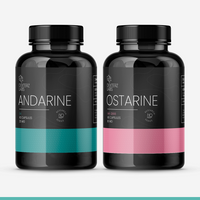
Three compounds dominate the cutting category and they work through entirely different mechanisms. Ostarine is a selective androgen receptor modulator. Cardarine, code GW-501516, is not a SARM at all but an agonist of the peroxisome proliferator-activated receptor delta, a transcription factor involved in fatty acid oxidation. Stenabolic, code SR-9009, is an agonist of the REV-ERB nuclear receptors, part of the circadian clock machinery. Andarine S-4 is sometimes added on the basis of animal data. Grouping them as fat loss SARMs is a retail convention that obscures the fact that only one of them binds the androgen receptor.
What the research found
Ostarine, phase II. In the study by Dalton and colleagues published in the Journal of Cachexia, Sarcopenia and Muscle in 2011, 120 healthy older men and postmenopausal women received placebo or 0.1, 0.3, 1 or 3 mg of enobosarm daily for 12 weeks. The headline result was a gain of about 1.3 kg of lean body mass at 3 mg. Total fat mass fell modestly at the higher doses, and the change was small next to the lean mass gain. This is the strongest human fat-mass signal in the whole SARM literature, and it amounts to a secondary endpoint in a trial about muscle, in subjects who were not dieting.
Cardarine, lipids in metabolic syndrome. Olson and colleagues, writing in Arteriosclerosis, Thrombosis and Vascular Biology in 2012, gave GW501516 to subjects with low HDL cholesterol and characteristics of metabolic syndrome. HDL rose and triglycerides fell. An earlier study by Sprecher and colleagues in the same journal in 2007 gave 10 mg daily for two weeks to healthy moderately obese men and recorded a rise in HDL of roughly 17 per cent and a fall in triglycerides of around 30 per cent.
Cardarine, liver fat. The most directly relevant human study is by Risérus and colleagues, published in Diabetes in 2008. Moderately obese men received 2.5 mg of GW501516 daily for two weeks. Liver fat content, measured by magnetic resonance spectroscopy, fell by around 20 per cent. Fasting triglycerides and apolipoprotein B fell, and markers of fatty acid oxidation rose. Body weight and total fat mass were not the endpoints and did not change meaningfully over two weeks.
Cardarine, endurance in animals. The famous exercise-endurance finding comes from mice, in work by Narkar and colleagues published in Cell in 2008, where GW501516 combined with exercise training increased running endurance and shifted muscle towards oxidative fibre types. The compound alone, without training, did far less. That study is the origin of the “exercise in a pill” headlines and it was not conducted in humans.
Stenabolic. SR-9009 was described by Solt and colleagues in Nature in 2012. In diet-induced obese mice, the REV-ERB agonists reduced fat mass and increased energy expenditure. The compound was given by intraperitoneal injection, not orally, because its oral bioavailability is poor. Later work by Dierickx and colleagues, published in PNAS in 2019, found that several of SR-9009’s cellular effects occur in cells lacking REV-ERB altogether, which complicates the mechanistic story considerably. There is no human trial of SR-9009.
Side effects reported
For Ostarine, the trials recorded dose-dependent falls in total testosterone and SHBG and a reduction in HDL cholesterol, all reversible. For Cardarine, the short human studies were tolerated, but the compound’s development was discontinued after long-term rodent carcinogenicity studies found tumours in multiple organ systems. That finding, not efficacy, is why GW501516 never reached a phase III trial, and it is the single most important fact about the compound. WADA issued an unusual public warning about it in 2013 because of the health risk to athletes. For SR-9009 there is no human safety data of any kind.
Across the category, the published case reports of drug-induced liver injury associated with products labelled as SARMs, including the series by Flores and colleagues in Hepatology Communications in 2020, apply here as much as anywhere, and contaminated product is a recurring feature of those reports.
Comparison with related compounds
Set against established evidence, the numbers are modest. A trained person in a controlled energy deficit loses fat at rates far exceeding anything recorded as a secondary endpoint in these trials, and a twelve-week enobosarm study in non-dieting older adults tells you nothing about a lean person cutting. Cardarine’s human data concerns lipids and liver fat over two to twelve weeks, not body fat over a diet. MK-677 is often mentioned in cutting discussions but raised fat-free mass without reducing fat mass in the Nass two-year study, and increases appetite. Andarine’s fat-loss reputation rests on animal work and user reports, not human trials.
Legal status in the UK, 2026
None of these compounds is controlled under the Misuse of Drugs Act 1971. Each is an unlicensed medicine under the Human Medicines Regulations 2012 if sold or advertised for human use, enforced by the MHRA, so all are sold strictly for research. Cardarine and Stenabolic are prohibited in sport at all times under section S4.4 of the WADA list as metabolic modulators, and Ostarine under S1.2. Cardarine is among the compounds most frequently identified in contaminated supplement cases.
How to check a supplier
Ask for the batch-specific certificate of analysis rather than a generic document. It should identify the compound by HPLC or LC-MS, state a purity percentage, and show a batch number that matches the bottle. Check for UK manufacture, a stated amount per capsule, a capsule count and a research-only notice. Dexterz Labs Cardarine GW-501516 is made in the UK at 10 mg per capsule, 90 capsules per bottle, and every batch is independently tested with its certificate of analysis published on the product page.
Frequently asked questions
Which compound has the best human fat-loss data? None has good human fat-loss data. Cardarine has the most relevant human metabolic data, on liver fat and lipids over two weeks, and Ostarine has a small secondary fat-mass reduction in a twelve-week trial.
Is Cardarine a SARM? No. It is a PPAR-delta agonist and does not bind the androgen receptor.
Why was Cardarine abandoned? Long-term rodent studies found tumours across multiple organs, and development stopped.
Does SR-9009 work orally? The rodent studies that produced its reputation used injection because oral bioavailability is poor, and there is no human data.
Do any of these replace a calorie deficit? Nothing in the published literature supports that idea, and no trial has tested any of these compounds against or alongside a controlled diet.
Are they detectable in sport testing? Yes. All are on the WADA Prohibited List and are routinely detected.
Related reading
- Cardarine (GW-501516): the research guide
- Stenabolic (SR-9009): what the research shows
- Ostarine (MK-2866): the complete research guide
- Are SARMs safe? What the evidence says about side effects
- Browse the range: SARMs UK, or the cutting stack bundles
Research product: Dexterz Labs Cardarine GW-501516 10 mg, 90 capsules
Related peptides in the research
The metabolic and endurance literature runs alongside a separate set of peptides: NAD+, studied in mitochondrial and ageing models, 5-Amino-1MQ, an NNMT inhibitor studied in adipose tissue, and HGH Fragment 176-191, the lipolytic fragment of growth hormone. Guide: NAD+: what the research says. For how SARMs and peptides differ in mechanism, evidence and storage, read SARMs vs peptides. You can buy research peptides UK from the Origin Peptides range.
Sources
- Dalton JT et al., J Cachexia Sarcopenia Muscle 2011;2:153-161. PubMed 22031847
- Risérus U et al., Diabetes 2008;57:332-339. PubMed 18024853
- Sprecher DL et al., Arterioscler Thromb Vasc Biol 2007;27:359-365. PubMed 17110604
- Olson EJ et al., Arterioscler Thromb Vasc Biol 2012;32:2289-2294. PubMed 22814748
- Narkar VA et al., Cell 2008;134:405-415. PubMed 18674809
- Solt LA et al., Nature 2012;485:62-68. PubMed 22460951
- Dierickx P et al., PNAS 2019;116:12147-12152. PubMed 31127047
- Nass R et al., Ann Intern Med 2008;149:601-611. PubMed 18981485
- Flores JE et al., Hepatol Commun 2020;4:450-452. PubMed 32140660
- WADA Prohibited List 2026.