
TLB-150 is sold by SARMs Store strictly as a research compound. Nothing on this page is medical advice or an instruction for human use.
This page starts with the most important sentence in it, because every other sentence depends on it. There are no published studies of TLB-150. None. Not one trial, not one pharmacokinetic study, not one animal experiment in the peer-reviewed literature under either of its names. Everything written about this compound anywhere, including here, is inference from the molecule it derives from and from general principles of ester chemistry.
What TLB-150 is
TLB-150, also sold as RAD-150, is described by suppliers as the benzoate ester of RAD-140. RAD-140, testolone, is a non-steroidal selective androgen receptor modulator developed by Radius Health and characterised by Miller and colleagues in ACS Medicinal Chemistry Letters in 2011. It binds the androgen receptor with high affinity and selectivity, showed anabolic activity in rodent and primate models, and was later taken into a clinical programme in hormone receptor positive breast cancer. It is covered in detail in the RAD-140 pillar, including the liver signal from its human work.
TLB-150 takes that molecule and attaches a benzoate group through an ester linkage. That is the whole modification, and it is why the compound exists commercially rather than scientifically: esterification produces a distinct chemical entity with a distinct name.
What esterification actually does
Esters are familiar from injectable androgens, where testosterone enanthate, cypionate and undecanoate all release the same parent hormone at different rates. The mechanism there is physical. Attaching a fatty acid chain makes the molecule more lipophilic, so when suspended in oil and injected it partitions slowly out of the depot into the bloodstream, where esterases cleave the ester and free the parent hormone. The longer the chain, the slower the release. This is well documented pharmacology, described in the clinical literature on testosterone preparations by Behre, Nieschlag and others.
The problem in applying that reasoning to TLB-150 is that it is sold as an oral capsule, not an oil depot injection. Without the depot, the mechanism that makes injectable esters long-acting does not operate. An orally administered ester meets gut and hepatic esterases immediately, and for many ester prodrugs cleavage is rapid and near complete during first pass. The resulting pharmacokinetics may resemble the parent compound closely, may differ in absorption, or the ester may survive to some degree. Which of these happens is an empirical question answered by a pharmacokinetic study, and no such study has been published for TLB-150.
A second consideration is mass. A benzoate group adds molecular weight without adding activity, so milligram for milligram an ester delivers less parent compound. That is arithmetic rather than speculation.
The claim that TLB-150 has a longer half-life, better oral stability or reduced liver burden than RAD-140 is therefore a hypothesis. It is not an unreasonable one, and it is not tested.
What is inferred from RAD-140
Because TLB-150 is understood to cleave to RAD-140, the RAD-140 literature is the only relevant evidence base.
Miller and colleagues, in 2011, described the design and preclinical characterisation of RAD-140, reporting high androgen receptor binding affinity, tissue selectivity favouring muscle over prostate, and anabolic effect in animal models. Jayaraman and colleagues, in Endocrinology in 2014, reported neuroprotective effects in rat models. The breast cancer programme generated the human exposure data, and the aspect most relevant here is the hepatic signal: elevations in liver enzymes were reported, and a published case report describes drug-induced liver injury in a man who used a product labelled as RAD-140.
If TLB-150 does cleave to RAD-140, everything in that paragraph applies to it, including the liver findings. Adding an ester group does not remove the properties of the molecule it releases.
Side effects reported
There is no safety dataset for TLB-150 because there is no dataset of any kind. The expected profile, inferred entirely from RAD-140, includes suppression of endogenous testosterone and luteinising hormone, reduced sex hormone binding globulin, falls in HDL cholesterol, and the potential for raised liver enzymes. The case report literature on drug-induced liver injury associated with products sold as SARMs, including RAD-140, is the most serious part of that picture.
The absence of adverse reports specific to TLB-150 is not reassurance. It reflects the absence of any systematic observation, not the absence of effect.
Comparison with related compounds
Set against Ostarine the contrast could hardly be sharper. Ostarine has phase I, II and III human trial data, a published effect size, a characterised side effect profile and years of anti-doping detection work behind it. TLB-150 has nothing. Set against RAD-140 itself, TLB-150 is a derivative with an unproven modification and a lower proportion of active compound by weight, offered in place of a compound that is itself among the less well documented SARMs. Set against LGD-4033, which has a published phase I dose-ranging study in healthy young men, the gap is again total. The commercial argument for TLB-150 is novelty. The scientific argument does not currently exist.
Legal status in the UK, 2026
TLB-150 is not a controlled substance under the Misuse of Drugs Act 1971. It is non-steroidal and does not fall within the Class C anabolic steroid provisions. Sold or advertised for human use it is an unlicensed medicine, which the MHRA enforces, so it is supplied here strictly for laboratory research.
For athletes the position should be assumed to be prohibited. Selective androgen receptor modulators are banned at all times under section S1.2 of the WADA Prohibited List, which is written to capture the class rather than only named examples. A compound that cleaves to RAD-140 would be expected to produce RAD-140 metabolites, which accredited laboratories detect.
How to check a supplier
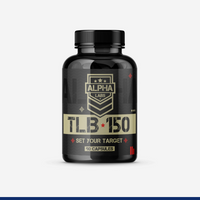
For a compound with no literature at all, the certificate of analysis is the only objective information that exists about what you are handling. Ask for the batch-specific document from an independent laboratory, with identity confirmed by HPLC or LC-MS rather than a generic assay, a stated purity figure, and a batch number matching the bottle. Identity confirmation matters particularly here: distinguishing a benzoate ester from the unesterified parent requires proper analysis, and the incentive to sell the cheaper parent under the newer name is obvious. Check the label declares amount per capsule, capsule count and a research-only notice. Alpha Labs TLB-150 is made in the UK at 5 mg per capsule, 90 capsules per bottle, and batch certificates of analysis are being published on the product page as testing is completed.
Frequently asked questions
Is TLB-150 the same as RAD-150? Yes. The two names refer to the same material, the benzoate ester of RAD-140.
Are there any studies on TLB-150? No. There is no published study of this compound in humans, in animals or in vitro under either name.
Does the ester make it longer-acting? That is the claim. Ester chemistry produces slow release from an injected oil depot, which is not how this product is administered, and no pharmacokinetic study has tested the question.
Is it stronger than RAD-140? There is no basis for saying so. The ester group adds molecular weight without adding activity, so per milligram it delivers less parent compound.
Does it avoid the liver issues reported with RAD-140? There is no evidence for that claim. If it cleaves to RAD-140, the properties of RAD-140 apply.
Is TLB-150 legal in the UK? It is not a controlled drug. It is an unlicensed medicine if sold for human use, so it is sold as a research compound only, and should be treated as prohibited in sport.
Related reading
- RAD-140 (Testolone): what the studies show
- Ostarine (MK-2866): the complete research guide
- Are SARMs safe? What the studies and case reports show
- Third-party testing: how to read a certificate of analysis
- Browse the range: prohormones range
Research product: Alpha Labs TLB-150 5 mg, 90 capsules
Sources
- Miller CP et al., ACS Med Chem Lett 2011;2:124-129 (RAD-140 preclinical characterisation). PubMed 24900290
- Jayaraman A et al., Endocrinology 2014;155:1398-1406. PubMed 24428527
- LoRusso P et al., Clin Breast Cancer 2022;22:67-77 (RAD-140 first-in-human study). PubMed 34565686
- Barbara M et al., ACG Case Rep J 2020;7:e00409 (liver injury with products labelled as RAD-140). PubMed 33062783
- Behre HM and Nieschlag E, clinical literature on testosterone ester pharmacokinetics.
- WADA Prohibited List 2026, section S1.2.
No published literature exists on TLB-150 itself.