
Last updated 18 September 2026 · SARMs Store editorial team. This guide describes published research on a compound sold by SARMs Store strictly for laboratory use. Nothing here is medical advice, a dosing instruction or a recommendation for human consumption.
M-Sten (Methylstenbolone) at a glance
| Chemical name | 2,17a-dimethyl-5a-androsta-1-en-17b-ol-3-one |
|---|---|
| Also sold as | M-Sten, Methylstenbolone, Ultradrol, Methyl-Sten |
| Class | 17a-methylated compound; structurally related to methasterone (Superdrol) |
| Highest evidence | Anti-doping metabolite studies and hepatology case reports; no controlled human trial |
| Aromatisation | Does not aromatise (1-ene, 2-methyl A ring) |
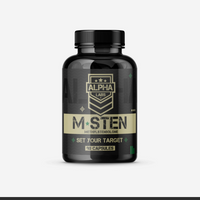
| Format | Capsule, 5mg, 90 per bottle |
| UK status 2026 | Not a licensed medicine; research use only; WADA S1 prohibited at all times |
What M-Sten is
Methylstenbolone is a synthetic androgen first described in a 1960s Searle patent and never developed as a medicine. It is a 2-methyl, 17-alpha-methyl derivative of stenbolone with a double bond at the 1 position. The 17-alpha-methyl group makes it orally active and is the modification associated across the class with cholestatic liver injury; the 2-methyl and 1-ene features resemble methasterone, the compound sold as Superdrol until it was withdrawn.
M-Sten reached the retail market around 2011 under the name Ultradrol, after methasterone was removed from sale.
What the research shows
There is no controlled human study of methylstenbolone. The primary literature has two strands. The first is analytical: Cavalcanti and colleagues at the Rio de Janeiro anti-doping laboratory published the human urinary metabolite profile in 2013, confirming that the compound is absorbed intact, extensively metabolised, and detectable for sport by the standard anti-doping screen. Later work from Cologne extended the metabolite list.
The second strand is clinical case reporting. Hepatology journals in the United States and Europe have published a cluster of cases of cholestatic jaundice, some severe, in men who used products labelled as methylstenbolone or Ultradrol, with recovery over months after stopping. The pattern is the same one documented for methasterone, and the mechanism is attributed to the 17-alpha-methyl group. Several of those reports involved products found on analysis to contain undeclared compounds, which again is the argument for batch testing in this category.
Receptor work on the compound itself is sparse. Its structural relatives (methasterone, stenbolone) bind the androgen receptor strongly and do not aromatise, and retail descriptions of M-Sten as a dry, non-aromatising compound rest on that structural inference rather than on measured data.
How M-Sten differs from epistane and trenavar
All three are prohibited in sport, but they are different chemistries. Epistane is a 17-alpha-methylated epitiostanol derivative with anti-oestrogenic heritage. Trenavar is a non-methylated 19-nor precursor that must be converted to trenbolone. M-Sten is a 17-alpha-methylated dihydrotestosterone-family compound related to methasterone, which places it with the group carrying the strongest liver signal in the case literature. Researchers comparing the three should weight that difference heavily.
Legal status in the UK, 2026
Methylstenbolone is not a licensed medicine; selling or advertising it for human consumption would make it an unlicensed medicinal product, and SARMs Store sells it strictly for laboratory research. It is prohibited at all times in sport under WADA S1.1. Country guides: USA, Australia, Canada.
Testing and how to read the certificate
Products sold as M-Sten have a documented record of substitution with methasterone or other compounds, which makes identity testing the whole point of the certificate. It should show identity by HPLC or LC-MS against a methylstenbolone reference standard, a purity figure, and the batch number matching the bottle. Alpha Labs M-Sten is encapsulated in the UK at 5mg per capsule. Every batch is independently tested and its certificate of analysis is published on the product page and on the Lab Testing page. See how to read a certificate of analysis.
Frequently asked questions
Is M-Sten the same as Superdrol?
No, but they are close relatives. Superdrol is methasterone; M-Sten is methylstenbolone, which differs by a double bond at the 1 position. Both are 17-alpha-methylated and both appear in the cholestatic liver injury case literature.
Is M-Sten a SARM?
No. It is a 17-alpha-methylated compound, not a SARM.
What has the research found about liver effects?
Published case reports describe cholestatic jaundice in men who took products labelled as methylstenbolone, consistent with the class effect of 17-alpha-methylated compounds. No controlled human safety study exists.
Is every batch tested?
Yes. Every batch is independently tested and its certificate of analysis is published on the product page and the Lab Testing page.
Key references
Geldof L et al. In vitro metabolism study of methylstenbolone. Drug Testing and Analysis 2014 to 2016 (Ghent and Cologne laboratories).
Case series of cholestatic liver injury associated with methylstenbolone and methasterone products: Hepatology, Journal of Clinical Gastroenterology and Clinical Toxicology, 2012 to 2020.
WADA Prohibited List 2026, S1.1.
Related guides
- Prohormones collection
- Epistane research guide
- Trenavar research guide
- What the research says about PCT
- How to read a certificate of analysis
- SARMs 101 hub
Research products: Alpha Labs M-Sten 5mg, 90 capsules · Alpha Labs Epistane · Alpha Labs Trenavar · PCT and Cycle Support · Lab Testing