
Updated September 2026. SARMs Store sells research compounds only. Nothing on this page is medical advice or an instruction for human use.
Search results on this subject are dominated by pages ranking compounds for women without reference to a single study that included one. The literature is thinner than the search volume implies, but it is not empty, and it points in a particular direction: the women in these trials were overwhelmingly postmenopausal, often with a clinical condition, and the outcomes measured were rarely the ones being marketed. This guide sets out exactly what the research contains, what it does not contain, and why the androgenic side of the risk profile applies differently.
Why female physiology is a separate question
Androgen receptors are present in muscle, bone, skin and hair follicle in both sexes, so an androgen receptor agonist acts on the same tissues. What differs is the hormonal background. Circulating testosterone in women is roughly a twentieth to a fifteenth of the level in men, so a given quantity of an exogenous receptor agonist represents a far larger relative change against baseline. That is the pharmacological reason androgenic effects in women appear at amounts that would be unremarkable in men, and it is the reason a compound’s dose-response data in men transfers badly.
The selectivity claim for this class is precisely about that: these compounds were engineered to act in muscle and bone with less activity in prostate, skin and hair follicle than testosterone, and none is converted to dihydrotestosterone or to oestrogen. Selectivity, however, is relative and dose-dependent, not absolute.
What the research contains
The Ostarine phase II included women. Dalton and colleagues, Journal of Cachexia, Sarcopenia and Muscle, 2011. The 120 participants were healthy older men and postmenopausal women, randomised to placebo or 0.1, 0.3, 1 or 3 mg of enobosarm daily for 12 weeks. Lean body mass rose by about 1.3 kg at 3 mg and stair-climb power improved. The trial reported the compound as well tolerated, and virilising effects were not reported at the doses studied. This remains the most relevant single dataset, and its participants were postmenopausal, not young and training.
Stress urinary incontinence trials in women. Enobosarm was taken into trials in postmenopausal women with stress urinary incontinence, on the rationale that androgen receptor activity in pelvic floor muscle might improve continence. Results in the earlier studies were reported by the sponsor as showing reductions in incontinence episodes, with later work less clear cut, and the programme did not lead to approval. The interesting point for this page is not the endpoint but the population: several hundred postmenopausal women have received enobosarm in a supervised setting.
Breast cancer. Enobosarm has been studied in phase II trials in women with androgen receptor positive, oestrogen receptor positive metastatic breast cancer, where the rationale is that androgen receptor signalling opposes oestrogen-driven tumour growth, and research in that indication continued into 2026. Separately, the only human trial of RAD-140 is the first-in-human study in women with hormone receptor positive breast cancer reported by LoRusso and colleagues in Clinical Cancer Research in 2022, in which raised liver transaminases were the most frequent adverse event and limited dose escalation.
Read together, the female data in this field is oncology and urology research in postmenopausal women, plus one body composition trial. There is no trial of any SARM in healthy premenopausal women, none in trained female athletes, and none measuring the outcomes that the market sells.
Side effects reported, and virilisation
At the doses in the enobosarm trials the compound was well tolerated in the postmenopausal participants, with the same measurable changes recorded across the SARM literature: reductions in sex hormone binding globulin and a fall in HDL cholesterol.
The risk that applies with particular force to female physiology is virilisation. With androgenic compounds generally, the documented effects are deepening of the voice, growth of facial and body hair, scalp hair loss in a male pattern, acne, clitoral enlargement and menstrual disruption. Some of these, notably voice changes and clitoral enlargement, are recognised in the endocrine literature as potentially irreversible once established, which is what separates them from the reversible hormonal changes seen in male trial participants. The more androgenic compounds sold in this category, including S-23, S-4 and the prohormones, carry more of this risk than enobosarm, and the prohormones carry the most because they are metabolised to active androgens without any selectivity at all. No study has characterised the threshold at which virilisation begins for any SARM, in any population.
Androgens are also contraindicated in pregnancy because of the risk of virilisation of a female foetus, a principle established across the androgen literature rather than tested with these compounds.
Comparison with related compounds
Among the compounds sold here, enobosarm is the only one with human data in women measuring body composition. MK-677 is not an androgen and the two-year trial by Nass and colleagues in the Annals of Internal Medicine in 2008 included older adults of both sexes, with increased fat-free mass and no androgenic effects, its issues being appetite and insulin sensitivity instead. Cardarine and Stenabolic are metabolic compounds with no androgen receptor activity, but Cardarine’s development was discontinued after rodent carcinogenicity findings and Stenabolic has no human data at all. The compounds with the strongest reputations for potency are the ones with the least female data.
Legal status in the UK, 2026
These compounds are not controlled under the Misuse of Drugs Act 1971. Under the Human Medicines Regulations 2012 they are unlicensed medicinal products if sold or advertised for human use, enforced by the MHRA, so they are supplied strictly for laboratory research. They are prohibited in sport at all times under the WADA list and apply equally to female athletes, with Ostarine the most frequently detected SARM in anti-doping samples across both sexes.
How to check a supplier
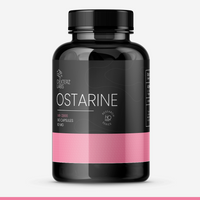
The verification standard does not change: a batch-specific certificate of analysis rather than a generic document, identity confirmed by HPLC or LC-MS, a stated purity percentage, a batch number that matches the bottle, UK manufacture, a clear amount per capsule and a research-only notice. The contamination finding by Van Wagoner and colleagues in JAMA in 2017, that only 52 per cent of 44 products sold online contained the labelled compound and 39 per cent contained a different unapproved drug, matters more here than anywhere, because an undeclared androgen carries consequences in female physiology that may not reverse. Dexterz Labs Ostarine is made in the UK at 10 mg per capsule, 90 capsules per bottle; batch certificates of analysis are being published on the product pages as testing is completed.
Frequently asked questions
Have any SARM trials included women? Yes. The Ostarine phase II included postmenopausal women, and the incontinence and breast cancer programmes were conducted in women.
Is there data in healthy younger women? No. No trial of any SARM has been conducted in healthy premenopausal women.
Which compound has the most female data? Enobosarm, by a wide margin, across body composition, urology and oncology research.
What is virilisation? Development of male characteristics from androgen exposure, including voice deepening, hair pattern changes, acne and menstrual disruption. Some effects are recognised as potentially irreversible.
Do the milder compounds avoid it? No study has established a threshold for any compound, so nobody can state one. The enobosarm trials did not report virilising effects at 3 mg daily or below in postmenopausal women.
Is MK-677 an androgen? No. It is a growth hormone secretagogue and does not act on the androgen receptor.
Related reading
- Ostarine (MK-2866): the complete research guide
- Are SARMs safe? What the evidence says about side effects
- SARMs vs anabolic steroids vs prohormones: the pharmacology and the law
- Third-party testing: how to read a certificate of analysis
- Browse the range: SARMs UK range
Research product: Dexterz Labs Ostarine MK-2866 10 mg, 90 capsules
Sources: Dalton JT et al., J Cachexia Sarcopenia Muscle 2011;2:153-161. LoRusso P et al., Clin Cancer Res 2022;28:4831-4841. Nass R et al., Ann Intern Med 2008;149:601-611. Van Wagoner RM et al., JAMA 2017;318:2004-2010. Flores JE et al., Hepatol Commun 2020;4:450-452. Human Medicines Regulations 2012. WADA Prohibited List 2026.